
Published: 10 August 2026
Last checked: 11 August 2026
Source: ESA / relevant official safety guidance
Mallorca is preparing for the total solar eclipse on Wednesday 12 August 2026, but amid all the excitement about where to watch it, road closures and finding the perfect viewpoint, there is one piece of advice that matters more than anything else:
Do not look directly at the Sun during the partial stages of the eclipse without proper eye protection.
The European Space Agency has published guidance explaining how to watch a solar eclipse safely and avoid permanent damage to your eyesight.
The good news is that enjoying the eclipse safely is straightforward, provided you use the right equipment and follow a few basic rules.
Complete guide to the Mallorca Eclipse 2026
Why is looking at an eclipse dangerous?
A solar eclipse does not make the Sun itself safer to look at.
During the partial phases, even when most of the Sun has been covered by the Moon, the remaining visible sunlight is still intense enough to damage the retina.
This can result in solar retinopathy, an injury to the light-sensitive tissue at the back of the eye. Damage can be permanent and, importantly, looking at the Sun may not hurt while the injury is happening.
That is why the advice is simple: if any part of the bright surface of the Sun is visible, protect your eyes.
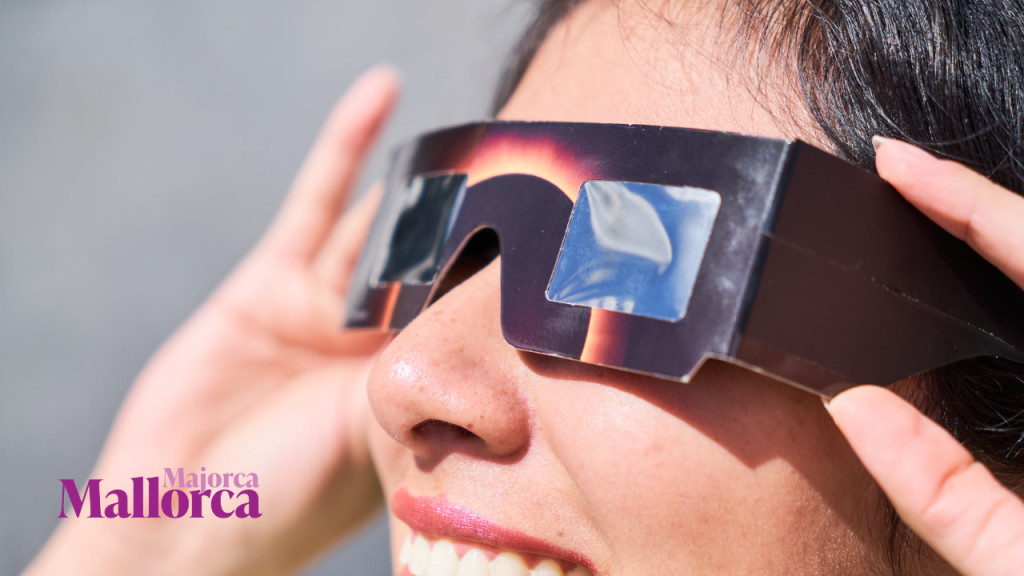
Use certified solar eclipse glasses
Ordinary sunglasses are not suitable for watching an eclipse, regardless of how dark they appear.
Instead, use proper solar viewing glasses designed specifically for observing the Sun.
Look for glasses that comply with the ISO 12312-2 international safety standard for direct solar viewing.
Before using them, inspect the lenses carefully.
Do not use eclipse glasses if they are:
- Scratched
- Cracked
- Punctured
- Torn
- Damaged in any other way
If in doubt, replace them.

What should you NOT use to watch the eclipse?
The European Space Agency warns against trying to create improvised solar filters.
Do not look at the Sun through:
- Smoked glass
- X-ray film
- Floppy disks
- CDs or DVDs
- Aluminium foil
- Photographic negatives
- Ordinary sunglasses
- Several pairs of sunglasses worn together
- Water used as a reflective surface
None of these provides reliable protection against the harmful radiation produced by the Sun.
Be particularly careful with cameras, binoculars and telescopes
Optical devices require even greater care.
Never look at the Sun through binoculars, a telescope or a camera without an appropriate solar filter designed for the equipment.
These devices concentrate sunlight and can increase the risk of severe eye injury.
A solar filter needs to be fitted correctly at the front of the optical equipment, before the sunlight enters the lens.
Do not simply put eclipse glasses on and then look through binoculars or a telescope.
The concentrated sunlight can damage the glasses and your eyes.
The same caution applies to photographing the eclipse. Phones and cameras should not be pointed directly towards the Sun unless suitable solar protection designed for that equipment is being used.
Can you take your eclipse glasses off during totality?
There is one very brief exception to the rule.
During a total solar eclipse, it is safe to view the Sun without eclipse glasses only during the period of complete totality, when the Moon completely covers the bright surface of the Sun.
In Mallorca, totality is expected to last for roughly a minute and a half, depending on your exact location.
This is when the Sun’s corona becomes visible around the dark Moon.
However, the moment the bright surface of the Sun begins to reappear, eclipse glasses must go back on immediately.
If you are uncertain whether totality has begun or ended, keep your glasses on.
Use an indirect viewing method
You do not have to look towards the Sun at all to enjoy the partial phases.
An indirect projection method can be a particularly good option for families and children.
A simple pinhole projector projects an image of the Sun onto another surface.
The important point is that you look at the projected image, not through the hole towards the Sun.
There are many simple ways to create a pinhole projector using cardboard or a box.
Protect yourself from the August sun too
Eye safety is not the only concern on 12 August.
The eclipse takes place during one of the hottest periods of the Mallorca summer, and many spectators may spend several hours waiting outdoors before totality.
Take:
- Sun cream
- A hat
- Light-coloured clothing
- Plenty of water
- Shade where possible
The brief darkness during totality does not remove the risks associated with spending the afternoon outside in strong August sunshine.
Take regular breaks
If you are observing the eclipse for an extended period, do not spend the entire partial phase continually watching it.
Take breaks, rest your eyes and enjoy what is happening around you too.
A total eclipse is much more than simply watching the Moon move across the face of the Sun.
The changing light, falling temperature and atmosphere around you are all part of the experience.
Ten basic rules for watching the Mallorca eclipse safely
To keep things simple:
- Never look directly at the Sun during the partial eclipse without proper protection.
- Use certified solar eclipse glasses complying with ISO 12312-2.
- Check eclipse glasses for damage before using them.
- Do not use ordinary sunglasses or homemade filters.
- Never look through binoculars, telescopes or cameras without appropriate solar filters.
- Only remove eclipse glasses during complete totality.
- Put your glasses back on immediately when the bright Sun starts to reappear.
- Consider using an indirect method such as a pinhole projector.
- Protect yourself from the heat with water, sun cream, a hat and appropriate clothing.
- If you are using specialist optical equipment, seek advice from an experienced astronomical organisation or supplier.
What eclipse glasses should I buy in Mallorca?
Look for glasses specifically manufactured for direct solar observation and displaying compliance with ISO 12312-2.
Avoid buying something simply because the seller describes it as “eclipse glasses”.
Check the packaging, manufacturer information and certification, and buy from a reliable supplier.
Given the enormous interest in the 12 August eclipse, do not leave buying them until the afternoon of the event.
The glasses are currently being sold in Farmacias and supermarkets all over the island.
What time is the Mallorca eclipse?
The partial phase of the eclipse begins at approximately 19:38 on Wednesday 12 August 2026.
Totality will occur at approximately 20:32, although the exact timing varies slightly depending on where you are in Mallorca.
The total phase will last for around 90 seconds in favourable parts of the island.
Because the eclipse occurs shortly before sunset, the Sun will be extremely low above the west-north-western horizon.
That makes choosing the right viewing location particularly important.
Planning where to watch the Mallorca eclipse
Eye safety is only part of the planning required for 12 August.
Mallorca will have major road restrictions, official observation areas, controlled access to some beaches and viewpoints and potentially significant traffic congestion.
We have put together a complete guide covering:
- Where to see the eclipse in Mallorca
- The nine official observation areas
- How to check whether you can see it from your accommodation
- Mallorca eclipse road closures
- Playa de Palma access restrictions
- Traffic and airport advice
- Fire safety
- Watching from a boat
- What to take with you
Read our complete Mallorca Solar Eclipse 2026 guide here
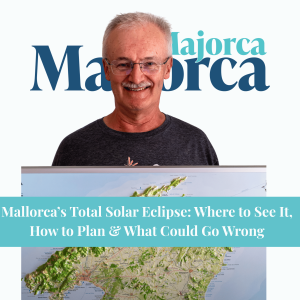
Listen to the Majorca Mallorca Eclipse Special
We have also recorded a special Majorca Mallorca podcast episode with Oliver and Nick Brown discussing the eclipse from a very local perspective.
Nick explains why Mallorca’s mountains make finding the right viewing location more complicated than people might expect, where views may be obstructed and why travelling across the island at the last minute could be a terrible idea.
Listen to the Majorca Mallorca Eclipse Special here
Enjoy the eclipse, but protect your eyes
The total solar eclipse on 12 August promises to be an extraordinary moment for Mallorca.
For around 90 seconds, daylight will disappear, the temperature may drop and the Sun’s corona will become visible around the Moon.
It should be unforgettable for all the right reasons.
Buy the proper glasses, use them correctly and make sure everyone watching with you understands when they must be worn.
No photograph or glimpse of the eclipse is worth permanently damaging your eyesight.
Safety information based on guidance published by the European Space Agency. Image and guidance credit: ©ESA.
This post may contain affiliate links that help support Majorca Mallorca in creating content like this. If you make a purchase using one of these links, Majorca Mallorca may receive compensation at no extra cost to you. Read our disclosure for more information.