
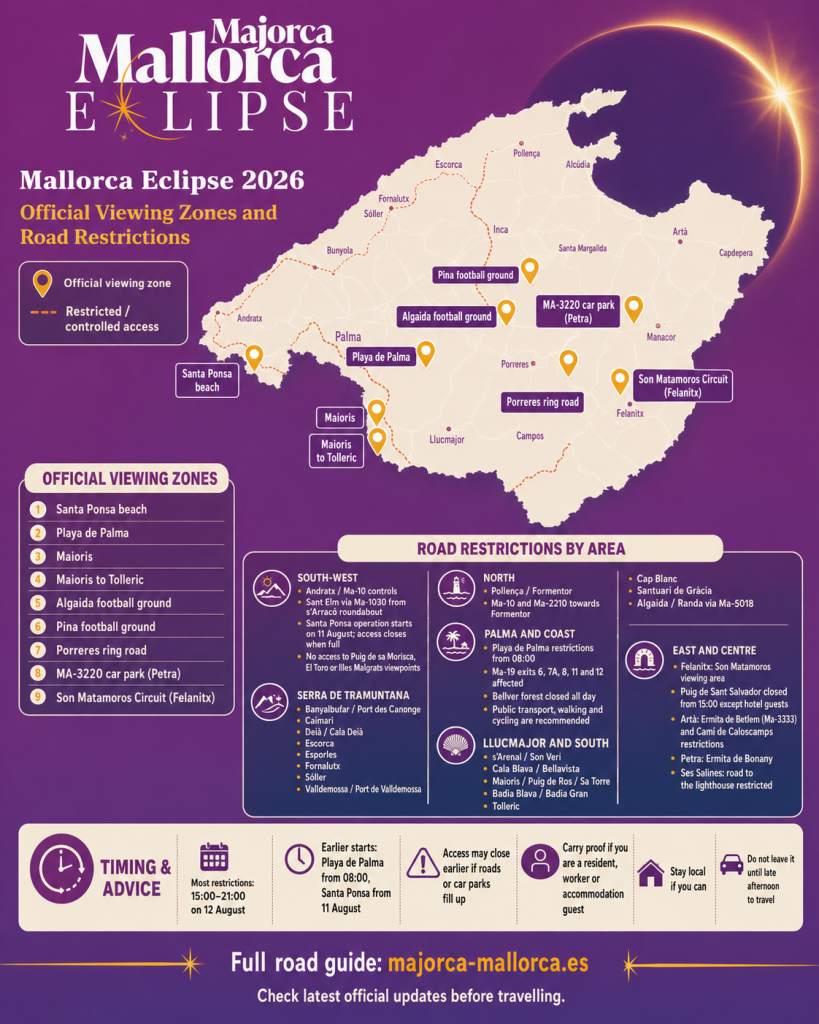
Mallorca eclipse viewing zones and road restrictions
This map summarises the official viewing zones and road/access restrictions for the 12 August 2026 total solar eclipse. Majorca Mallorca compiled this information from the latest official announcements. Last checked: 12 August 2026.
Official viewing zones: Santa Ponsa beach; Playa de Palma; Maioris; Maioris to Tolleric; Algaida football ground; Pina football ground; Porreres ring road; MA-3220 car park (Petra); Son Matamoros Circuit (Felanitx).
See the full road-by-road details below…
Sources: Govern de les Illes Balears / Consells Insulars / Ajuntaments — compiled by Majorca Mallorca. Updated 11 August 2026.
Next update due: if official information changes…
See all our Mallorca Eclipse 2026 information
Originally published: 27 July 2026
Last substantially updated: 11 August 2026
Latest information checked: 12 August 2026, 07:24 CEST
If you are planning to get public transport then download this app https://nova.emtpalma.cat/es/emt?pageId=nueva_app which shows you in real time the regular bus routes in Palma. If you are planning to travel outside of Palma then this company https://www.tib.org/es/inicio will help you with getting around.
Mallorca’s emergency and road services are now activating a major operational plan ahead of tomorrow’s total solar eclipse.
The Consell de Mallorca, Mallorca Fire Brigade and road teams will reinforce key areas across the island because of the large crowds expected at viewpoints, natural spaces and major access routes.
Extra fire and rescue teams in the Serra de Tramuntana
A fire crew with a light fire engine will be stationed in the Formentor area, while a specialist Mountain Rescue Group will be positioned around Lluc to respond quickly to incidents in the Serra de Tramuntana.
Mallorca’s eight fire stations will continue their normal emergency cover across the rest of the island.
70 road staff and around 30 specialist vehicles
From early in the morning, the Department of Territory, Mobility and Infrastructure will deploy around 70 staff and 30 specialist vehicles across ten areas of Mallorca.
Teams will be ready to deal with:
- Accidents
- Road obstructions
- Cleaning
- Traffic incidents
- Emergency closures
- Changes to access arrangements
Four additional vehicles carrying road-closure and traffic-control equipment will also move around the island wherever they are needed.
Monitoring at the Sóller tunnel will also be increased.
Road closures can change during the day
This is the key point for anyone travelling.
The traffic operation is designed to be flexible, which means roads can be closed, reopened or restricted at short notice depending on congestion, crowd numbers and safety conditions.
Do not assume that because a road is open in the morning it will still be open later in the afternoon.
Check the latest official information before setting off, avoid unnecessary journeys and keep your plans flexible.
SEE ROAD CLOSURES IN DETAIL
Update: workers will need proof to enter restricted eclipse zones
Workers who need to access areas affected by Mallorca’s eclipse traffic restrictions on Wednesday 12 August should make sure they are carrying documents proving why they need to enter.
The Balearic Government says acceptable proof can include a work contract, company certificate or payslip.
This applies to people working inside areas where road controls are in place, including hotels, restaurants and other businesses. Simply telling officers that you work there may not be enough.
Restrictions affecting around twenty roads are generally expected to begin from 3pm, although they may start earlier if traffic or safety conditions require it.
Playa de Palma has separate access rules
For Playa de Palma, workers entering the controlled zone by private vehicle will need the relevant QR accreditation.
People travelling by public transport, on foot or by non-motorised transport do not need the vehicle permit.
If you are working inside one of the restricted areas on Wednesday, sort your documentation now rather than discovering at a checkpoint that you cannot get through.
The traffic operation includes the closure of Ma-19 exits 6, 7A, 8, 11 and 12 in the Llucmajor direction.
From 08:00 until 12:00, access to Playa de Palma will be limited to residents, accredited workers and guests staying in accommodation with parking, provided they have the necessary accreditation.
From 12:00 onwards, restrictions will extend more widely to vehicles, subject to the official exceptions.
People arriving by public transport, on foot or by bicycle do not need accreditation.
More practical details have now been confirmed for several of Mallorca’s official eclipse viewing areas, particularly Santa Ponça, Playa de Palma and Son Matamoros in Felanitx.
The message from the authorities remains the same: these locations have been chosen because they can be managed safely, not necessarily because they offer the island’s very best view of the eclipse.
Santa Ponça
Santa Ponça beach is one of Mallorca’s official observation zones, and the special operation there begins 24 hours before the eclipse, on 11 August. Capacity will be monitored throughout the event and, once the maximum is reached, access will be closed. Access will also be restricted to Puig de sa Morisca and viewpoints including El Toro and the Illes Malgrats.
Residents and people who can prove a justified reason for entering a controlled area may still be allowed access.
Son Matamoros, Felanitx
At the official viewing area at Son Matamoros, vehicle capacity is limited to 800 cars.
Once that figure is reached, vehicle access will close. To make the route safer for people walking from Felanitx, the speed limit on the access road will be reduced to 20 km/h for two or three hours.
The site will also have:
- An ambulance
- Portable toilets
- Water available to buy
- Additional private security staff
Scroll down for the map showing the official viewing areas
Mallorca’s official viewing locations are:
- Son Matamoros Circuit
- Playa de Palma
- Porreres ring road
- Santa Ponça beach
- Algaida football ground
- Pina football ground
- Maioris to Tolleric
- Ma-3220 parking area
- Maioris
Remember, these are not necessarily the places with the clearest or most spectacular views. They have been selected because authorities can better manage access, capacity, parking and emergency services.
If you are planning to use one of them on Wednesday, arrive early, check access arrangements before leaving and have an alternative plan in case your chosen location reaches capacity.
Update: Santa Ponça beach visibility will be restricted.
Subscribe below to get our final Mallorca eclipse update.
Join the Majorca Mallorca newsletter for confirmed road closures, transport information, weather forecasts
and last-minute official announcements before 12 August.
CLICK TO LISTEN TO THE PODCAST HERE
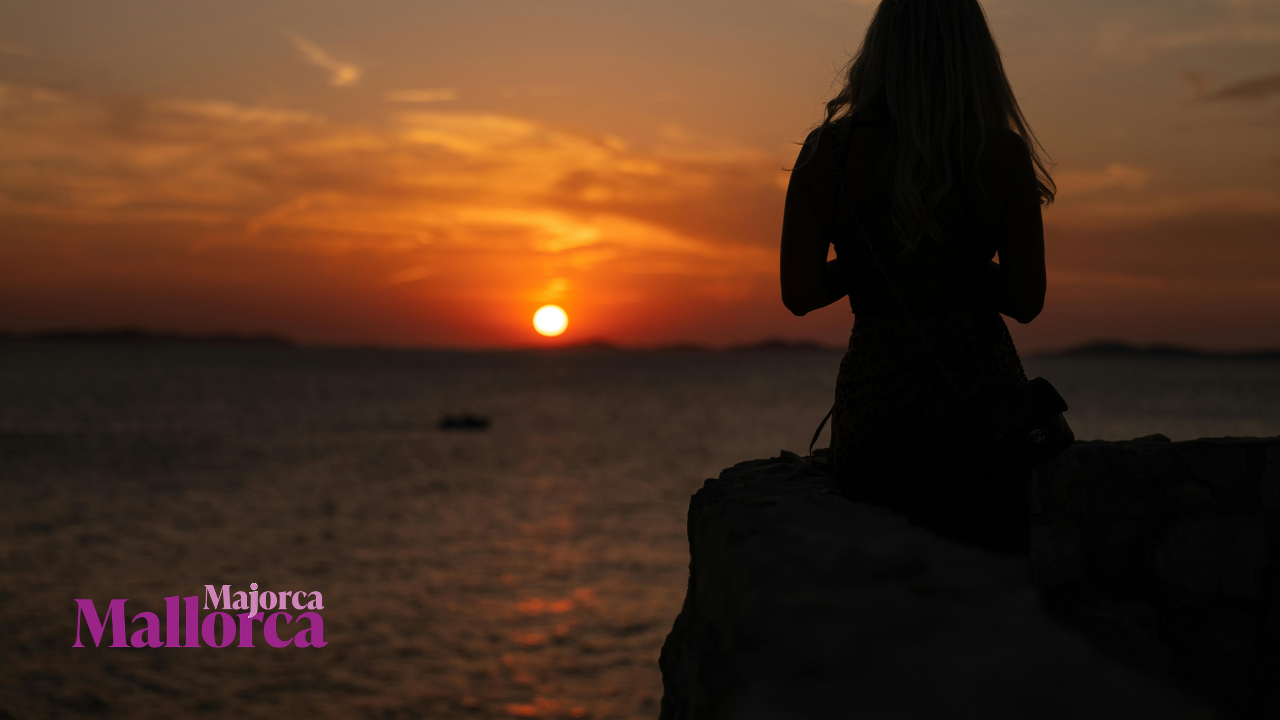
Why could the Mallorca eclipse be difficult to see?
The eclipse reaches totality only a short time before sunset.
At its maximum, the Sun will be extremely low in the west-north-western sky.
That means something which would normally seem insignificant can completely obscure the event.
It could be:
- A mountain
- A hill
- A headland
- A hotel
- An apartment block
- A tree
- Even a slight rise in the landscape
For much of Mallorca, looking west-north-west also means looking towards the Serra de Tramuntana.
From places relatively close to the mountains, the Sun could disappear behind the peaks before totality begins.
This is why the perfect eclipse location is not necessarily the island’s most famous sunset spot.

Can you see the eclipse from Palma?
Possibly, but location will matter enormously.
Much of Palma city has the Serra de Tramuntana between it and the low western Sun, with buildings creating another layer of potential obstruction.
Parts of Playa de Palma, Can Pastilla and s’Arenal may offer significantly better possibilities, which is one reason Playa de Palma has been chosen as one of the official observation areas.
A rooftop, hotel terrace or other elevated position may also provide a better line of sight than street level.
If you are already staying somewhere with a clear view, check it carefully before deciding to travel elsewhere.
How to check whether you can see the eclipse from home
The free Horizonte Eclipse 2026 tool allows people to select a location and check whether the maximum phase should be visible above the natural horizon. It uses topographical information to assess the height of the surrounding landscape and includes a compass and simulation features. This makes it a valuable starting point, but it should not be treated as an absolute guarantee. The website may account for mountains and hills, but a nearby hotel, pine tree or apartment block could still ruin the view.
The safest approach is:
- Check the proposed location using Horizonte Eclipse 2026.
- Visit the location before eclipse day, preferably on 11 August, to minimise the difference between what you are seeing then and what will happen on the day of the eclipse.
- Look briefly towards the sunset at approximately the same time, do not stare at the sun for too long.
- Check for buildings, trees and other nearby obstructions.
- Choose a safe place with enough room for the number of people expected.
- Prepare an alternative nearby location.
The Balearic Government recommends watching from home, a nearby location or your accommodation whenever possible, rather than making a long journey across the island.
Choose the exact location you are considering and check the natural horizon.
Then, if possible, check the physical location itself beforehand.
The simple pre-eclipse test
There is also a very practical way of checking your proposed viewing spot.
Using proper ISO 12312-2 certified solar eclipse glasses, check whether you can see the Sun from the exact location at:
- 9 August at 20:36
- 10 August at 20:35
- 11 August at 20:34
If the Sun is visible from that position at the relevant time, you have a good indication that the horizon should be open enough for the eclipse.
Do not look directly at the Sun without proper solar viewing glasses.

Where are the official eclipse viewing areas in Mallorca?
The Balearic Government has designated nine official observation zones, known as Zonas Oficiales de Observación or ZOO.
Importantly, these have not necessarily been selected because they offer the most dramatic view.
They were chosen by considering factors such as:
- Visibility
- Accessibility
- Capacity
- Parking
- Crowd management
- Emergency-service access
This is an important distinction.
The official viewing area may be the safest place to manage thousands of people, but it is not automatically the location with Mallorca’s finest eclipse view.
The nine official Mallorca eclipse viewing areas
The designated locations are:
- Algaida football pitch
- Maioris Decima
- Maioris to Tolleric
- Playa de Palma
- Petra, parking area on the Ma-3220
- Pina football pitch
- Porreres
- Santa Ponça beach
- Son Matamoros Circuit, Felanitx
Use our interactive Mallorca eclipse map to explore the nine official viewing areas, possible visibility locations and places where traffic or access restrictions are expected. Always check the latest official advice before travelling, as arrangements may change before 12 August.
NB: Residents do not get priority at official viewing areas
This is worth emphasising.
Being a Mallorca resident does not give you priority entry into an official observation area.
The areas are open to both residents and visitors.
Entry is based on available capacity and, when the authorities consider an area full, access can be closed.
That means living nearby does not guarantee that you can turn up at the last minute and get in.
This is separate from road restrictions, where residents, workers and people with other justified reasons may qualify for vehicle access.
Playa de Palma eclipse viewing area
https://www.google.com/maps/d/u/1/edit?mid=1xlY_q6bBHla1RKc8voBnKB6YHu8wa3w&usp=sharing
Playa de Palma is expected to absorb the largest number of spectators.
Palma City Council has referred to an optimum capacity of around 75,000 people, although it has not published an exact number at which the area will be considered full.
Once capacity is reached, further access may be stopped.
Playa de Palma vehicle restrictions
Vehicle restrictions will operate from 8am until midnight.
The controlled zone includes the area between Balneario 4 and Torrent des Jueus, close to the Llucmajor municipal boundary.
Most people travelling there specifically to watch the eclipse should not expect to drive into the area.
Workers and customers of participating businesses with registered private parking may receive QR access passes.
People heading to the eclipse viewing area are instead being encouraged to:
- Use public transport
- Walk
- Cycle
- Stay within walking distance if already in the area
Selected Ma-19 exits will also be regulated as part of the traffic operation. The official Government road list specifically identifies exits 6, 7A and 8.
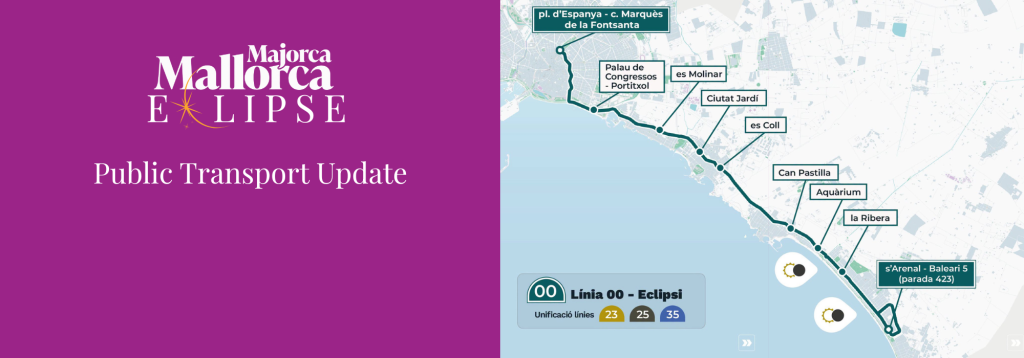
Going to Playa de Palma for the eclipse? EMT Palma has created a special bus service just for the day.
For the total solar eclipse on Wednesday 12 August, EMT Palma will run a new “00 Eclipsi” service designed specifically to move people between central Palma and the coast.
The special route will combine the usual services of lines 23, 25 and 35 into one continuous route from Plaça d’Espanya to s’Arenal, Balneari 5.
The service will run from 12 noon on 12 August until 2am on 13 August, with buses approximately every five minutes.
The route will serve key points including:
• Plaça d’Espanya
• Palau de Congressos / Portitxol
• Es Molinar
• Ciutat Jardí
• Can Pastilla
• Aquarium
• La Ribera
• s’Arenal, Balneari 5
There will also be changes to the normal network during the day.
Lines 23, 25 and 35 will stop running their usual routes from 12 noon, with the special 00 Eclipsi service taking over. Line 25 will begin operating on a diversion from the evening of 11 August, while other services including 18, 28, 31 and 32 will also be partially diverted from midday on the 12th.
EMT is advising passengers to check the latest information on its website, app and at affected stops before travelling.
If you are planning to watch the eclipse from Playa de Palma, this is another very good reason to leave the car at home and use public transport.
What is prohibited in Playa de Palma?
Restrictions include:
- Fireworks
- Open fires
- Barbecues
- Glass containers
- Tents
- Structures that could obstruct emergency access
With tens of thousands of spectators potentially in one area, clear routes for police, ambulances and other emergency services are essential.
Santa Ponça eclipse viewing area
https://www.google.com/maps/d/u/1/edit?mid=1xlY_q6bBHla1RKc8voBnKB6YHu8wa3w&usp=sharing
Santa Ponça beach is Calvià’s official viewing zone.
The operation begins 24 hours before the eclipse, on 11 August.
Capacity will be monitored and, once the maximum is reached, access will be closed.
Restrictions will also affect sensitive surrounding locations, and people should not assume they can simply divert to a nearby viewpoint once Santa Ponça is full.
Son Matamoros in Felanitx
https://www.google.com/maps/d/u/1/edit?mid=1xlY_q6bBHla1RKc8voBnKB6YHu8wa3w&usp=sharing
The Circuito de Son Matamoros is the official observation area for Felanitx.
Vehicle capacity is limited to 800 vehicles. Once that capacity is reached, further vehicle access will be closed.
People who can walk from Felanitx are being encouraged to do so.
Facilities will include:
- Portable toilets
- An ambulance
- Water for sale
- Additional security staff
Smoking is completely prohibited because of the high temperatures and fire risk.
Leaving rubbish, particularly glass and plastic, is also prohibited.
Do not head to Puig de Sant Salvador instead
Vehicle access to Puig de Sant Salvador will close from 15:00, except for hotel guests with reservations.
The authorities specifically warn that the sanctuary is not a suitable eclipse observation point because visibility is insufficient.
Algaida and Pina
https://www.google.com/maps/d/u/1/edit?mid=1xlY_q6bBHla1RKc8voBnKB6YHu8wa3w&usp=sharing
Unlike many municipalities, Algaida has published some approximate capacity figures.
The Pina football pitch is expected to accommodate around 150 to 200 people.
The area beside the Algaida football ground will accommodate around 500 people.
These are relatively small numbers compared with Playa de Palma, another reason not to leave arrival until the last minute.
Porreres
The original Porreres viewing location raised concerns about visibility, and arrangements have subsequently been altered.
A location near the industrial estate has been prepared, with parking for around 200 vehicles.
There will also be additional policing because the eclipse coincides with the town’s patron saint celebrations.
Petra
https://www.google.com/maps/d/u/1/edit?mid=1xlY_q6bBHla1RKc8voBnKB6YHu8wa3w&usp=sharing
Petra also has an official observation area, located in the designated parking area.
At the time of writing, specific spectator capacity arrangements have not been published.
Access towards Bonany is, however, included in the Government’s regulated-road list.
Two additional viewing areas in Manacor
Manacor Council has also created two municipal viewing areas outside the official Govern ZOO network:
- Parc de na Molla (https://maps.app.goo.gl/BHyNMrnsPuTgcc8aA)
- s’Illot football ground (https://maps.app.goo.gl/gKW7uuzQYCkqWTt59)
These are being managed directly by Manacor Council.
Mallorca eclipse road closures and traffic restrictions
Traffic management is likely to be one of the biggest challenges of the day.
The Government has identified regulated routes across Mallorca, including roads in:
Andratx and south-west Mallorca
- Andratx, Ma-10
- Ma-1030 towards Sant Elm
Serra de Tramuntana
- Banyalbufar and Port des Canonge
- Caimari
- Deià and Cala Deià
- Escorca
- Esporles
- Fornalutx
- Sóller
- Valldemossa and Port de Valldemossa
Palma and Playa de Palma
- Selected Ma-19 exits
- Controlled Playa de Palma access
Llucmajor and southern Mallorca
- Roads serving Badia Blava
- Badia Gran
- Cap Blanc lighthouse
- Ses Salines
Central Mallorca
- Algaida and Randa
- Petra and Bonany
East and north-east Mallorca
- Artà and Ermita de Betlem
- Felanitx and Puig de Sant Salvador
Northern Mallorca
- Pollença
- Ma-10 sections
- Ma-2210 towards Formentor
The Government’s official road-control list gives the individual roads and affected kilometre points.

When will the road restrictions start?
Many restrictions are expected to operate from around 15:00 until 21:00, although the authorities can introduce them earlier or keep them in place longer if traffic, crowding, parking, fire risk or other safety considerations require it.
Playa de Palma has earlier controls beginning at 08:00, while Santa Ponça’s operation begins the previous day.
Do not make plans based on arriving five minutes before a published closure time.
If a road becomes overwhelmed earlier, controls can change.
Who can access restricted roads?
Depending on the particular restriction, access may still be possible for:
- Residents
- People with homes within a controlled area
- Accredited workers
- Hotel guests
- Public transport
- Emergency services
- People with an urgent justified need
- In some areas, customers with bookings and confirmed private parking
Documentation may be required.
An emergency or unavoidable journey can also be assessed by officers at the control point, but access remains subject to their decision.
Can you walk or cycle into an eclipse area?
In some locations, yes.
Restrictions aimed specifically at motor traffic do not automatically mean pedestrian or bicycle access is prohibited.
However, individual locations can still be closed because of:
- Capacity
- Fire risk
- Emergency conditions
- Environmental protection
- Specific local restrictions
Do not assume that a bicycle guarantees access everywhere.
Could Mallorca experience serious traffic problems?
Very easily.
The eclipse occurs in the middle of August when Mallorca is already operating close to peak seasonal capacity.
Beaches, roads, towns, car parks and public transport are busy before anybody adds a once-in-a-generation astronomical event.
If tens of thousands of people decide at 18:00 that they should really be somewhere else, the island simply does not have infinite road capacity.
The smartest journey on eclipse day may be the one you do not make.
Will there be toilets at the official eclipse viewing areas?
Not necessarily.
Not every official observation area will have toilets or identical facilities.
Practical arrangements have largely been left to the individual municipalities.
If this is important to you, check the relevant town hall information before setting off, particularly if you will be waiting for several hours with children or older relatives.
Where else might you see the eclipse in Mallorca?
There is no single “best place” for everybody.
In many cases, the best viewing position may be a safe open area within walking distance of where you are staying.
South and south-east Mallorca
Parts of southern Mallorca may offer more favourable views because of the increased distance from the Serra de Tramuntana.
Areas around Llucmajor, Colònia de Sant Jordi, sa Ràpita and sections of the south coast may provide suitable horizons, depending on local obstructions.
Remember, however, that access to some beaches and sensitive areas will be regulated.
Mallorca’s east coast
Parts of the east coast may also have a view over the island towards the eclipse.
Visitors staying around Cala d’Or, Portocolom, Porto Cristo or Cala Millor should check their exact location rather than assuming that an entire resort will have the same view.
A few streets or a little extra elevation may make a considerable difference.
Northern Mallorca
Northern Mallorca is more complicated.
From some locations, Puig Major and other sections of the Serra de Tramuntana may sit directly in front of the setting Sun.
Parts of Alcúdia, Can Picafort, Pollença and the north-east may have very localised viewing opportunities, but the horizon needs to be checked carefully.
Port de Sóller
Port de Sóller looks, at first glance, like an obvious eclipse destination.
However, its horseshoe-shaped bay and surrounding hills mean that some areas could have the Sun hidden before totality.
Do not assume that an “eclipse dinner” or waterfront booking automatically comes with a clear view.
Should you head into the Serra de Tramuntana?
Probably not unless you have already made a very careful and realistic plan.
The western side of Mallorca may offer spectacular possibilities, but it also creates the greatest problems.
There are:
- Limited roads
- Limited parking
- Very dry terrain
- High fire risk
- Narrow mountain paths
- Restricted vehicle access
- Few places capable of safely accommodating very large crowds
The official tourism advice is to watch close to your accommodation wherever possible rather than travelling to famous mountain peaks, cliffs and protected natural areas.
Andratx, s’Arracó and Sant Elm eclipse restrictions
The western end of Mallorca is one of the areas where careful planning is particularly important.
The Government’s official regulated-road list includes both the Ma-10 at Andratx and the Ma-1030 towards Sant Elm, beginning from the roundabout connection near s’Arracó.
In practical terms, anyone hoping to drive towards Sant Elm or into the mountains late in the afternoon should think again.
People in s’Arracó and the surrounding area may find that walking to a suitable local position is considerably more realistic than trying to drive elsewhere.
And yes, plenty of us have a “secret” viewing spot.
Unfortunately, approximately 3,000 other people may have discovered the same secret.
Flying from Palma Airport on 12 August?
Even people who have absolutely no interest in the eclipse could be affected by it.
If you are flying into or out of Palma on Wednesday 12 August:
- Check your airline
- Check traffic conditions
- Arrange transport in advance
- Allow considerably more time than usual
- Avoid travelling via eclipse viewing areas
- Do not assume normal August journey times will apply
Traffic measures around Playa de Palma and the Ma-19 are intended in part to protect important access routes, but congestion elsewhere can still have knock-on effects.
If you have a flight, this is not the day to cut your airport arrival time fine.
Watching the Mallorca eclipse from a boat
The sea could provide an exceptional view because it removes many of Mallorca’s landscape obstructions.
It will not necessarily be a peaceful one.
A high concentration of vessels is expected.
Official guidance advises boat users to:
- Check the weather
- Carry appropriate life jackets, lights and safety equipment
- Maintain a safe speed
- Keep a safe distance from other vessels
- Watch for swimmers
- Monitor VHF Channel 16
- Avoid alcohol when operating the vessel
- Never use flares except in an emergency
- Take all rubbish back to land
And, importantly, never anchor on Posidonia seagrass.
An eclipse is not an exemption from normal maritime or environmental rules.
Guardia Civil eclipse operation
The Guardia Civil is preparing a significant operation for eclipse day involving personnel and specialist units on land, at sea and in the air.
The priorities include managing traffic, protecting natural areas, preserving emergency access and dealing with incidents quickly.
People travelling to eclipse locations are being encouraged to plan ahead and take enough water, food and fuel to cope with delays.
Do not:
- Block hard shoulders
- Block forest tracks
- Park across emergency access
- Enter private land
- Drive onto agricultural land
- Park on dry vegetation
Parking a hot vehicle on very dry vegetation can itself present a fire hazard.
Wildfire risk during the Mallorca eclipse
This may be the most important non-astronomical issue of the evening.
August is hot, dry and already a high-risk period for wildfires.
Now add large numbers of people walking into countryside that they may not know particularly well.
Do not:
- Smoke
- Light candles
- Use a camping stove
- Light a barbecue
- Use fireworks
- Leave glass
- Discard cigarettes
- Leave rubbish
- Park vehicles on dry vegetation
Please take everything home with you.
If you see smoke or signs of a fire, call 112.
The official tourism guidance also stresses the need to protect the environment and combine eclipse viewing with responsible behaviour.
Remember, you may be walking back in the dark
If you walk into the countryside at 18:00 or 19:00, you will probably be returning after sunset.
A path which seems straightforward in daylight can feel very different in darkness.
Take:
- Suitable shoes
- A torch or headtorch
- Plenty of water
- A fully charged phone
- A power bank if necessary
Do not rely solely on your phone torch if you are taking a serious mountain route.
How to watch the eclipse safely
This part is non-negotiable: looking directly at the Sun during the partial phases can cause permanent retinal damage.
Ordinary sunglasses are not enough, neither are several pairs of sunglasses worn together.
Use proper eclipse glasses
Use solar eclipse glasses meeting ISO 12312-2 standards. These are being sold all over the island in Farmacias and Supermarkets.
The official Balearic guidance specifically recommends glasses compliant with this standard.
Check glasses before use for scratches, holes or damage.
Do not use homemade filters
Do not rely on:
- Smoked glass
- CDs or DVDs
- Photographic negatives
- X-ray film
- Ordinary sunglasses
- Homemade filters
Cameras, phones, telescopes and binoculars
Do not point cameras, phones, binoculars or telescopes directly at the Sun unless they have suitable solar protection designed for that equipment.
Eclipse glasses are for your eyes. They are not a substitute for a proper filter fitted to photographic or optical equipment.
What happens during totality?
During complete totality, when the bright surface of the Sun is fully covered, the corona becomes visible.
Eye protection must go back on as soon as the bright surface of the Sun starts to reappear.
If you are unsure, keep the glasses on.
A safe indirect projection method, such as a properly constructed pinhole projector, is another option for observing the partial phase.
What should you take with you to watch the Mallorca eclipse?
A few minutes of astronomy may involve several hours of waiting.
Take:
- ISO 12312-2 eclipse glasses
- Plenty of water
- Food or snacks
- Sun cream
- Hat
- Appropriate clothing
- Suitable footwear
- Torch or headtorch
- Fully charged phone
- Power bank
- Any medication you need
- A rubbish bag
- Patience
And prepare for the possibility that the location you originally wanted may already be full.
Your Mallorca eclipse checklist
Before 12 August
- Check whether you can see the eclipse from your accommodation
- Use Horizonte Eclipse 2026
- Check the physical horizon before eclipse day
- Buy proper certified eclipse glasses
- Check the latest official traffic information
- Identify a local viewing option
- Prepare a Plan B
- Plan your return after dark
- Tell visiting friends and family about the disruption
On eclipse day
- Check the weather
- Check traffic and official alerts
- Arrive early
- Do not park illegally
- Keep emergency routes clear
- Protect your eyes
- Carry plenty of water
- Do not light fires
- Take your rubbish home
- Respect private property
- Follow police and emergency-service instructions
- Consider waiting for crowds to disperse before leaving
Stay local, plan early and enjoy it!
Mallorca’s total solar eclipse should be extraordinary.
For around 90 seconds, the evening will change completely as the Moon covers the Sun and the corona becomes visible around it.
But those 90 seconds have the potential to create hours of traffic, crowded viewpoints and considerable pressure on an island already in the middle of its busiest month.
So our advice is simple.
Do not chase the perfect Instagram location across Mallorca if you already have a perfectly good view close to where you are staying.
Check the horizon. Make a plan. Have an alternative. Take water. Bring the right glasses. Carry a torch. Leave no rubbish behind.
And please, please do not set fire to Mallorca while trying to watch the Sun disappear.
Listen to the Majorca Mallorca Eclipse Special with Oliver and Nick Brown for more detailed local advice about viewing locations, Mallorca’s geography and what to expect on 12 August.
For the very latest information on traffic, safety and access restrictions, check the official Balearic Government eclipse channels before travelling.
Want something to do AFTER the eclipse? Hang around for a few hours and you will see a meteor shower!
Perseid meteor shower 2026: how and when to see it in Mallorca
Mallorca Solar Eclipse 2026 FAQs
The total solar eclipse takes place on Wednesday 12 August 2026.
The partial phase begins at approximately 19:38.
Totality is expected at approximately 20:31 to 20:33, depending on the observer’s precise location.
Approximately a minute and a half in favourable locations.
The eclipse ends at around 20:49, effectively coinciding with sunset in Mallorca.
The Sun will be extremely low towards the west-north-west.
This low angle is why mountains, buildings and other obstructions are such an important issue.
Possibly, but much of central Palma may have an obstructed western horizon.
Parts of Playa de Palma and elevated locations may offer better opportunities.
Check your exact location rather than assuming the whole city has the same view.
Possibly, and if you can, staying at the hotel may be one of the smartest options.
Check with your accommodation and use Horizonte Eclipse 2026 to assess the horizon.
There are nine:
Algaida, Maioris Decima, Maioris to Tolleric, Playa de Palma, Petra, Pina, Porreres, Santa Ponça and Son Matamoros in Felanitx.
No.
Official viewing areas are open to residents and visitors alike and can close when capacity is reached.
Access can be closed and you will need an alternative.
Do not rely on being able to move quickly to another popular location once this happens.
Yes. Manacor Council has created municipal viewing areas at Parc de na Molla and s’Illot football ground, separate from the Govern’s nine official observation zones.
Not all of them.
Facilities vary according to municipality, so check before travelling.
Not necessarily.
Major traffic controls and restrictions will operate across Mallorca and some locations have very limited vehicle capacity.
Many restrictions are planned from around 15:00, although some begin earlier and any closure can be brought forward if conditions require it.
Playa de Palma has restrictions from 08:00.
Do not depend on it.
The Ma-1030 towards Sant Elm is part of the official regulated-road plan.
General access will be heavily restricted on a number of routes and sensitive areas.
Residents and people with justified access may be permitted through controls, but recreational eclipse traffic should not assume access will be possible.
In some places, yes, but access can still be stopped because of capacity, fire risk or a specific local closure.
Potentially.
Traffic congestion and Playa de Palma restrictions may affect journeys, so passengers should allow significantly more time.
Yes, but expect busy waters and follow normal navigation and maritime-safety requirements.
Monitor VHF Channel 16 and never anchor on Posidonia.
Use eclipse glasses compliant with ISO 12312-2.
Ordinary sunglasses are not sufficient.
Do not point a phone or camera directly towards the Sun without suitable solar filtration designed for the equipment.
Not without appropriate professional solar filters fitted correctly to the equipment.
Never look at the Sun through unfiltered binoculars or a telescope.
Use Horizonte Eclipse 2026 and check your western horizon beforehand.
You can also use certified eclipse glasses to check whether the Sun is visible from the same position at the equivalent times on 9, 10 or 11 August.
Move away from danger, follow emergency-service instructions and call 112.
Do not obstruct emergency routes.
About this guide
This guide has been written and updated by Vicki McLeod, co-founder and editor of Majorca Mallorca and a Mallorca resident since 2004.
Our analysis of eclipse visibility and Mallorca’s geography also draws on research by Majorca Mallorca contributor Nick Brown, who studied the island’s topography, viewing angles and potential obstructions ahead of the eclipse.
Nick joined Majorca Mallorca co-founder and podcast presenter Oliver for an in-depth discussion about eclipse viewing locations, road restrictions and the practical challenges facing the island on 12 August.
The guide is continually checked against information published by the Balearic Government, Mallorca’s local councils, emergency authorities and the Instituto Geográfico Nacional.
Official sources used for this guide
- Balearic Government, official eclipse information:
https://www.caib.es/webgoib/es/vols-saber-ho-tot-sobre-l-eclipsi-del-12-d-agost-de-2026- - Balearic Government, traffic restrictions and closures:
https://www.caib.es/webgoib/es/-/mesures-de-control-restricci%C3%B3-i-tancament-3 - Instituto Geográfico Nacional, 12 August 2026 eclipse calculations:
https://astronomia.ign.es/en/eclipses-de-sol-y-luna/eclipse-total-sol-de-12-de-agosto-2026 - IGN official eclipse map/visualiser:
https://visualizadores.ign.es/eclipses/2026 - Palma City Council:
https://www.palma.cat/
Palma is publishing its Playa de Palma traffic and transport updates there.
Please note: arrangements may still change according to traffic, capacity, weather, fire risk or emergency requirements. Always check the latest official information before travelling on 12 August.

This post may contain affiliate links that help support Majorca Mallorca in creating content like this. If you make a purchase using one of these links, Majorca Mallorca may receive compensation at no extra cost to you. Read our disclosure for more information.