
The History of Mallorca

Look out from Palma’s Parc de la Mar and you can see two chapters of Majorcan history side by side. The Gothic cathedral tells the story of the conquest of 1229. Beside it, the Royal Palace of La Almudaina stands on the site of the Muslim fortress that preceded it.
Travel beyond Palma and you’ll find older stories still, in a stone settlement outside Artà and a Roman theatre near Alcúdia.
Explore by period
Before Rome, the Talayotic settlements
Majorca’s prehistoric communities built settlements around large stone towers called talayots. At Ses Païsses near Artà, the central tower came first. Houses and other structures grew up around it, and a substantial outer wall enclosed the village.
What you can see today At Ses Païsses, start at the entrance, where huge upright stones support a stone lintel. Inside, look for the central talayot and the remains of the rooms built around it. Continue into town with our Artà area guide.
Roman Majorca, a town takes shape at Pollentia
Rome conquered Majorca in 123 BCE. Pollentia developed near present-day Alcúdia, on the narrow stretch of land between the bays of Pollença and Alcúdia. Its surviving street and building remains give a sense of how a Roman town worked.

What you can see today At the Roman site of Pollentia, look for houses at Sa Portella, the forum at the centre of public life and the theatre, where part of the seating was cut into the rock. Our Alcúdia area guide puts the ruins and the medieval old town on the same outing.
Islamic Majorca, the city of Madina Mayurqa
Majorca came under Muslim rule in the early 10th century. Palma, then called Madina Mayurqa, became the island’s principal city. The baths and the site of the old fortress offer two ways to see how the city was organised.
What you can see today At the Banys Àrabs, look up at the small openings in the hot room’s dome and at the mismatched column capitals beneath it. At La Almudaina, the early 14th-century palace incorporates traces of the earlier Muslim fortress. Look for the surviving private baths within the palace.
The conquest of 1229 and the Kingdom of Majorca
Jaume I of Aragon captured Madina Mayurqa in 1229. Work on a Gothic cathedral began in the 13th century after the former main mosque was consecrated for Christian worship. In 1276, Jaume I’s son Jaume II inherited the Kingdom of Majorca, which also included territories across the sea. The Crown of Aragon recovered the island in 1343. Jaume III’s attempt to retake it ended with his death at Llucmajor in 1349.

What you can see today At La Seu, look up at the tall nave and the great rose window. Construction continued for centuries, and Antoni Gaudí reworked parts of the interior in the early 20th century. At Castell de Bellver, commissioned by Jaume II around 1300, stand in the circular courtyard to see how unusual the castle’s plan is. Palma’s Call Maior walking route traces the streets of its medieval Jewish quarter and the history of the community that lived there.
Merchants, sea defences and Bourbon rule
In 15th-century Palma, merchants met at Sa Llotja to do business. Around the island, towns and watchtowers tell the other side of life beside busy Mediterranean sea routes. After the War of the Spanish Succession, Philip V’s 1715 Nueva Planta decree reorganised the way Majorca was governed.
What you can see today Inside Sa Llotja, follow the spiral columns up to the ribs of the vaulted ceiling. In Alcúdia’s old town, the gates, walls and bastions show how its defences changed over time. Above the coast at Banyalbufar, the Talaia des Verger dates to the late 16th century. From beside it you can see why this spot was chosen to watch the sea.
Modernisme, civil war and self-government
Around the turn of the 20th century, Majorcan Modernisme brought flowing lines and plant motifs to the homes and public buildings of prosperous towns such as Sóller. The Spanish Civil War brought repression to Majorca. Bellver’s royal rooms and courtyard survived, but the castle acquired a different role as a prison. Palma’s Republican mayor, Emili Darder, was among those held there before his execution in 1937.
Mass tourism reshaped much of the coast from the 1960s. Following Spain’s transition to democracy, the Balearic Islands gained their first Statute of Autonomy in 1983. The new parliament moved into a former social club in Palma that same year.
What you can see today At Can Prunera in Sóller, look for the stonework around the windows and the decorative ironwork on the façade. In Palma, the Balearic Parliament occupies the old Círculo Mallorquín on Carrer del Palau Reial, a short walk from the palace and cathedral. See our Sóller guide and Palma guide for more nearby stops.
Mallorca history timeline
Select a milestone to explore the event or read about the person behind it.
Read the 20 milestones as text
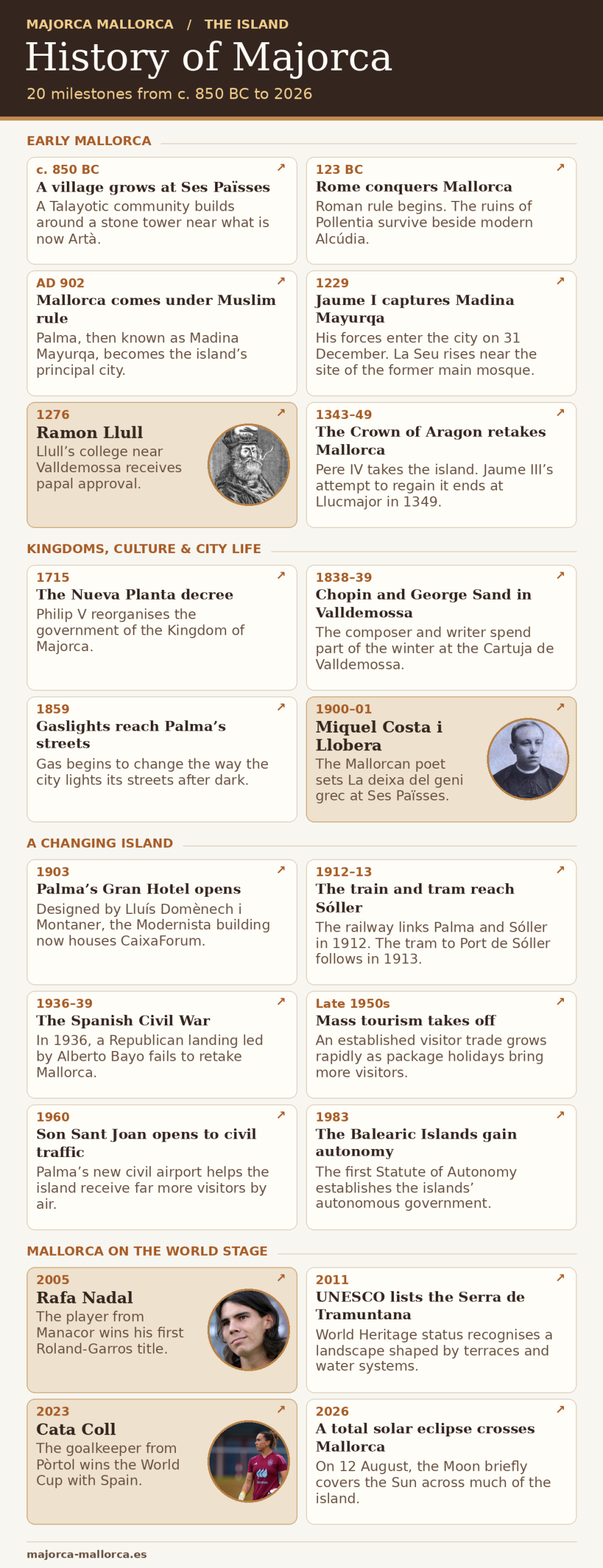
- c. 850 BCA village grows at Ses PaïssesA Talayotic community builds around a stone tower near what is now Artà.
- 123 BCRome conquers MallorcaRoman rule begins. The ruins of Pollentia survive beside modern Alcúdia.
- AD 902Mallorca comes under Muslim rulePalma, then known as Madina Mayurqa, becomes the island’s principal city.
- 1229Jaume I captures Madina MayurqaHis forces enter the city on 31 December. La Seu rises near the site of the former main mosque.
- 1276Ramon LlullLlull’s college near Valldemossa receives papal approval.
- 1343–49The Crown of Aragon retakes MallorcaPere IV takes the island. Jaume III’s attempt to regain it ends at Llucmajor in 1349.
- 1715The Nueva Planta decreePhilip V reorganises the government of the Kingdom of Majorca.
- 1838–39Chopin and George Sand in ValldemossaThe composer and writer spend part of the winter at the Cartuja de Valldemossa.
- 1859Gaslights reach Palma’s streetsGas begins to change the way the city lights its streets after dark.
- 1900–01Miquel Costa i LloberaThe Mallorcan poet sets La deixa del geni grec at Ses Païsses.
- 1903Palma’s Gran Hotel opensDesigned by Lluís Domènech i Montaner, the Modernista building now houses CaixaForum.
- 1912–13The train and tram reach SóllerThe railway links Palma and Sóller in 1912. The tram to Port de Sóller follows in 1913.
- 1936–39The Spanish Civil WarIn 1936, a Republican landing led by Alberto Bayo fails to retake Mallorca.
- Late 1950sMass tourism takes offAn established visitor trade grows rapidly as package holidays bring more visitors.
- 1960Son Sant Joan opens to civil trafficPalma’s new civil airport helps the island receive far more visitors by air.
- 1983The Balearic Islands gain autonomyThe first Statute of Autonomy establishes the islands’ autonomous government.
- 2005Rafa NadalThe player from Manacor wins his first Roland-Garros title.
- 2011UNESCO lists the Serra de TramuntanaWorld Heritage status recognises a landscape shaped by terraces and water systems.
- 2023Cata CollThe goalkeeper from Pòrtol wins the World Cup with Spain.
- 2026A total solar eclipse crosses MallorcaOn 12 August, the Moon briefly covers the Sun across much of the island.

Frequently asked questions
Where should I start if I only have a day in Palma?
Start at La Seu and La Almudaina, which face one another. Walk on to the Banys Àrabs, then head towards the waterfront and Sa Llotja. Bellver Castle is on a hill outside the old centre, so leave extra time if you want to include it.
For a walk with a puzzle to solve, try Adventure Hunt Palma. You follow clues through the old town at your own pace. If you’d rather see the city on two wheels, the Discover Palma bike tour takes you along the seafront towards La Seu and into the old town with a guide. Allow two and a half hours for the ride.
Where can I see Majorca’s pre-Roman and Roman remains?
Go to Ses Païsses in Artà for Talayotic stone buildings and to Pollentia in Alcúdia for Roman ruins. In Alcúdia, the Roman site and the medieval old town are close together, so you can see both in one visit.
Words for visiting historic sites
| English | Spanish | Catalan |
|---|---|---|
| Archaeological site | Yacimiento arqueológico | Jaciment arqueològic |
| Arab baths | Baños árabes | Banys àrabs |
| City wall | Muralla | Muralla |
| Watchtower | Torre de vigilancia | Talaia |
| Inner courtyard | Patio interior | Pati interior |
Read the History of Spain for the wider context, or explore more towns and villages in The Island guide.